
The Darjeeling Himalayan Railway & the Tea Trade
Before the railway, the world’s finest tea descended the Himalayas on the backs of porters and bullocks — expensive, slow, and damaging. Two engineers changed that in twenty-three months. What they built became an industrial marvel, a trade artery, and ultimately a World Heritage monument to the ingenuity that made Darjeeling tea possible.
Technical specification – dhr line no. 1
Drawing Ref: EBR/DHR/1881/SPEC-01
88 km
Siliguri to Darjeeling station
2 ft
610 mm narrow gauge
2,100 m
From 100 m to 2,200 m
23 months
1879 – 1881
6
To gain altitude on steepest grades
3
Including the famous Batasia Loop
1 in 22
Among steepest adhesion railways
5 Dec 1999
First industrial site in Asia
Prestage and Allan: The Men Who Solved the Mountain
Sir Franklin Prestage
Prestage was the administrative and commercial mind behind the DHR — the man who saw the railway’s necessity, argued its case to the government, secured the funding, and set the parameters within which Allan would work. His fundamental insight was the gauge question: rather than attempting to build a standard or metre-gauge railway that would have required extensive tunnelling and earthworks, Prestage proposed a 2-foot narrow gauge line that could follow the existing hill road’s alignment. This single decision made the project feasible. Without it, the DHR would almost certainly never have been built.
Alexander Allan
Allan was the field engineer who translated Prestage’s vision into 88 kilometres of working railway across terrain that had resisted every previous infrastructure attempt. His signature solutions were the zigzag reverses and loop spirals — neither was a new invention, but Allan’s application of both, simultaneously and repeatedly on a single line of this length, was unprecedented. The six zigzag reverses allowed the line to gain altitude on the mountain’s steepest faces by switching back on itself, using gravity as a partner rather than fighting it. The three loop spirals — where the line spirals over itself in a complete circle — gained elevation on the more moderate gradients with a balletic economy of earthwork. Allan built the entire 88-kilometre line in twenty-three months, on time and under budget.
“Allan did not conquer the mountain. He negotiated with it — finding the lines of least resistance, turning the terrain’s own geometry against itself, making the gradient that should have been the problem into the mechanism of the solution.”
On Allan’s engineering approach to the Himalayan gradient problem
The Gauge Decision: Why 2 Feet Changed Everything
The choice of 2-foot narrow gauge was not an economy measure — it was a geometric one. Narrow gauge allowed far tighter minimum turning radii: where a metre-gauge line needed a curve of at least 200 metres to maintain structural safety, a 2-foot gauge line could turn in 60 metres. On a mountain that twisted and folded on itself every few hundred metres, that difference was the entire project. The DHR’s minimum curve radius of 61 metres would have been impossible on any wider gauge, and every tunnel and cutting that wasn’t needed represented both cost saved and engineering time preserved.
The consequence was a line of extraordinary intimacy with its landscape. The DHR does not cut through the mountain — it follows it, shares the road with it, sits alongside the hill road for most of its length, close enough that passengers could reach out and touch the stone walls of roadside buildings. This intimacy, born of engineering necessity, became the railway’s most celebrated aesthetic quality and ultimately a significant part of what UNESCO recognised in 1999.
The Route: 88 Kilometres from Plains to Cloud
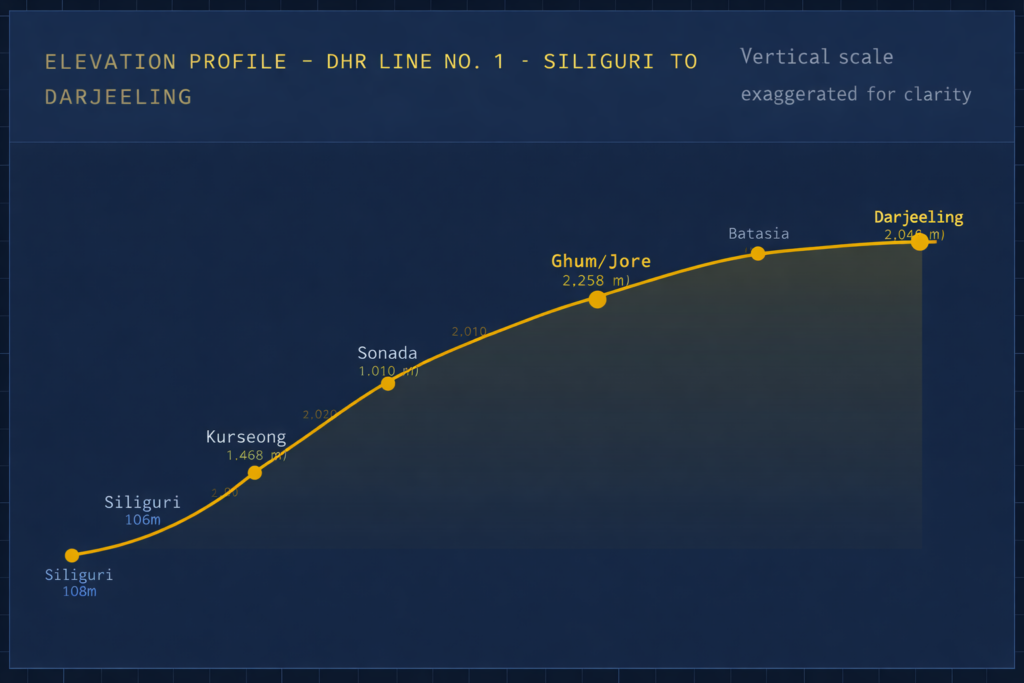
Siliguri Jn.
mahanadi
Kurseong
Ghum / Jore.
darjeeling
The zero tunnels figure is the most telling number in the entire specification. Allan achieved a 2,100-metre altitude gain over 88 kilometres without a single major tunnel — an achievement that represented an extraordinary economy of construction and an equally extraordinary faith in the geometry of the zigzag and the loop as altitude-gaining mechanisms. Every comparable mountain railway of the era relied heavily on tunnelling. The DHR did not, because on a 2-foot narrow gauge line with a minimum curve radius of 61 metres, the mountain’s own folds and creases were sufficient.
Jorebungalow: Where Tea Met the Railway
Of all the stations on the 88-kilometre line, one had a significance to the tea trade that exceeded every other. Jorebungalow — today’s Ghum station, at 2,258 metres the highest point on the entire route — was not the most scenic stop or the most populous, but it was the most commercially critical. It was where the upper district’s tea converged before beginning its long, controlled descent to the plains.
metres asl
Jorebungalow Station
Estates in the upper reaches of the Darjeeling district — those above 1,800 metres where the finest first flush and muscatel second flush teas were produced — had no practical road access to Kurseong or Siliguri for bulk goods movement. Jorebungalow was their answer. Tea chests from estates including Gopaldhara, Thurbo, Badamtam, and the upper sections of Makaibari were collected and consolidated at Jorebungalow’s goods shed before being loaded onto descending trains. The station’s goods traffic in the early twentieth century represented a significant portion of the district’s entire tea export volume.
The practical effect of the railway on the tea trade was immediate and transformative. Where a chest of tea had previously taken several days and significant porter cost to reach the plains, the DHR reduced the descent to a matter of hours. The cost reduction was substantial enough to render marginal estates commercially viable overnight — gardens whose elevation or road access had made the economics of bulk production barely workable found themselves, after 1881, in a fundamentally different commercial position.
The railway also solved a quality problem that the old porter-and-bullock system had never fully addressed. Tea chests subject to days of jarring, jolting mountain road travel arrived at Siliguri in worse condition than the same chests would have left the factory. The railway’s smooth, controlled descent — particularly after the adoption of steam braking systems on the steepest gradients — delivered tea in the condition it was packed. Grade integrity improved. Premiums increased. The quality case for Darjeeling tea strengthened.
Traffic and Trade: The Numbers by 1909
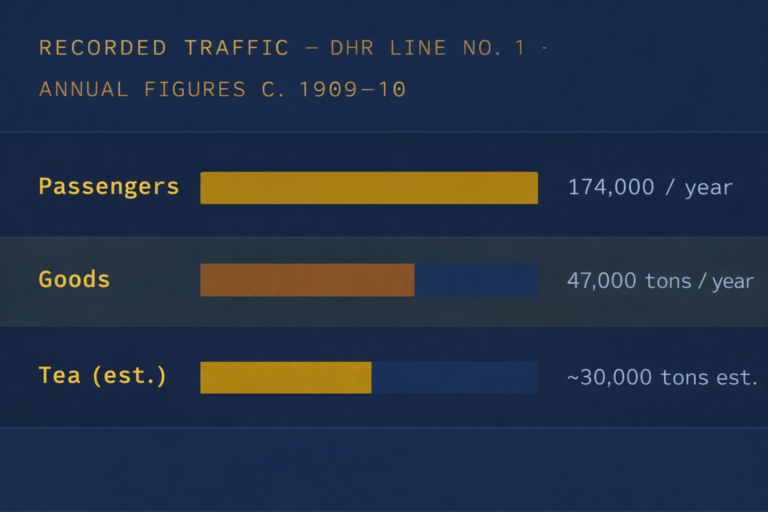
Within three decades of opening, the DHR had grown from a tea logistics solution into the primary transport artery of an entire hill district. By 1909–10, the line’s traffic figures told the story of a railway that had far exceeded its original commercial brief.
The 174,000 annual passenger figure — in 1909, in a Himalayan district of limited population — reflects the degree to which the DHR had become essential infrastructure rather than merely commercial logistics. Workers moved between gardens and towns. Students reached schools in Darjeeling. Merchants, government officials, and an emerging stream of tourists all depended on the line. The railway had done what no road system could accomplish: it had knitted the district together.
The 47,000 tons of annual goods traffic encompassed tea, timber, consumer goods moving uphill, and the accumulated produce of the hill economy moving down. Of that figure, tea constituted the majority of high-value freight — chests bound from Jorebungalow and Kurseong goods sheds to the Siliguri railhead, and from there by broad-gauge connection to Calcutta’s auction houses and export docks. The chain that ran from a Darjeeling estate’s packing room to a German importer’s warehouse had, by 1909, been compressed to a matter of days. The DHR was the reason.
“The railway did not simply reduce transport costs. It changed the economic identity of every estate on the mountain — turning altitude from a liability into a selling point by making high-grown tea as easy to move as low-grown.”
On the DHR’s transformative effect on the economics of high-altitude estates
Why Nepali Workers? The Argument of Altitude
The choice of recruiting primarily from Nepal and the surrounding hill regions was not arbitrary. Tea cultivation in Darjeeling was altitude work — plucking on slopes of 70 degrees, in cool and often wet conditions, at elevations between 600 and 2,000 metres. Workers from the Gangetic plains, where the majority of India’s agricultural labour lived, were physiologically and culturally ill-adapted to these conditions. Workers from Nepal’s hills were not. They had lived at altitude for generations. They understood the terrain, the cold, the rain, the physical demands of plucking on steep gradient. They were, in the most practical sense, the right people for the work.
Dakman Rai understood this before the British planters did. His recruitment networks preceded the formal expansion of the industry, ensuring that by the time gardens like Tukvar and Steinthal began scaling their operations, a trained and experienced workforce was already available. The speed with which the industry grew from 3 gardens in 1852 to 39 by 1866 and 113 by 1874 was, in significant part, a function of Rai’s demographic preparation.
“The Nepalese workers Dakman Rai recruited became not just the first generation of Darjeeling tea pluckers — they became the founding families of an entire hill community whose identity, culture, and political aspirations remain inseparable from the tea industry today.”
On the lasting demographic legacy of early labour recruitment, Darjeeling district
UNESCO 1999: The World Recognises What the Tea Trade Built
For most of the twentieth century, the DHR was a working railway, not a heritage object. Steam locomotives were replaced on some services by diesel railcars. The passenger network contracted as road access to the hills improved. By the 1980s and 1990s, the line faced real questions about its commercial future — a narrow-gauge railway sharing a road with motor vehicles in an era of cheap bus transport was not an obvious economic proposition.
UNESCO’s inscription on 5 December 1999 reframed the question entirely. The DHR became — overnight, and formally — not a struggling transport operator but a monument. The first industrial heritage site in Asia to achieve World Heritage status, recognised for the outstanding universal value of its engineering response to an extraordinary landscape challenge.
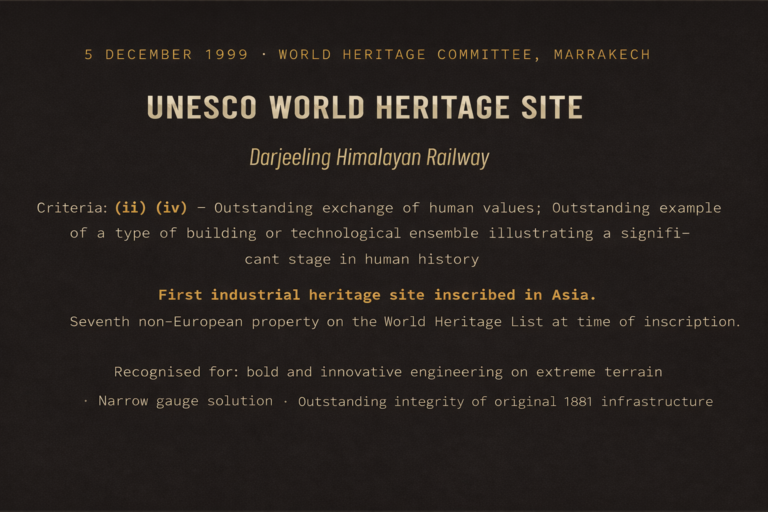
The inscription criteria — (ii) and (iv) in UNESCO’s framework — acknowledged two distinct claims. Criterion (ii) recognised the DHR as an outstanding example of human exchange of values: the transfer of British railway engineering knowledge to an Indian mountain context, adapted and refined to produce something the originating culture had never built. Criterion (iv) recognised it as an exemplar of a technological ensemble illustrating a significant stage in human history — the age of steam, the age of empire, and specifically the industrial logic that tea demand drove across the Victorian world.
The irony is precise: the railway was built entirely in service of tea. Every engineering decision — the gauge, the zigzags, the loops, the grade — was made in the context of the commercial imperative to move tea chests downhill cheaply and quickly. What UNESCO recognised in 1999 was the industrial monument that Darjeeling’s tea trade had built and then inadvertently bequeathed to the world as heritage. The Toy Train endures, ultimately, because of every chest of muscatel that ever rode it down the mountain.
Frequently Asked Questions
1. Why was the Darjeeling Himalayan Railway built?
The DHR was built between 1879 and 1881 primarily to reduce the cost of transporting tea from Darjeeling’s hill gardens to the plains at Siliguri. Before the railway, tea descended by bullock cart and porter — a slow, expensive process that constrained the industry’s growth and damaged the product. The railway reduced the journey from multiple days to hours and transformed the economics of every estate in the district.
2. Who built the Darjeeling Himalayan Railway?
The DHR was conceived by Sir Franklin Prestage, Agent of the Eastern Bengal Railway, and engineered by Alexander Allan. Prestage’s critical insight was to specify a 2-foot narrow gauge, allowing tight curves without tunnelling. Allan designed and built the full 88-kilometre line — including six zigzag reverses and three loop spirals — in twenty-three months, on time and under budget.
3. When did the Darjeeling Himalayan Railway receive UNESCO status?
The DHR received UNESCO World Heritage status on 5 December 1999, becoming the first industrial heritage site in Asia to be inscribed on the World Heritage List. It was recognised under Criteria (ii) and (iv) for its outstanding engineering response to extreme mountain terrain and as an exemplar of the technological ingenuity of the steam era.
4. What is the gauge of the Darjeeling Himalayan Railway?
The DHR runs on a 2-foot (610mm) narrow gauge. This gauge was chosen specifically by Sir Franklin Prestage because it allowed a minimum curve radius of 61 metres — tight enough to follow the existing hill road’s alignment without requiring tunnelling. The narrow gauge made the project financially and engineering feasible where any wider gauge would not have been.
5. What role did Jorebungalow station play in the Darjeeling tea trade?
Jorebungalow (now Ghum), at 2,258 metres the highest station on the DHR, was the key tea storage and consolidation point for the upper district’s estates. Tea from gardens above 1,800 metres — including some of the finest first flush and muscatel producers — was assembled at Jorebungalow before the controlled descent to Siliguri and onward to Calcutta’s auction houses and export docks.